The Myelocyte
I name the parent and the child before anything else. Parent: the promyelocyte. Child: the metamyelocyte. Every claim below carries its source.
The myelocyte and the marrow: everything the literature knows.
Before we go anywhere, here is the tree. Every cell you ask about has a parent and a child. I will name both before I say anything else. What line are we tracing today?
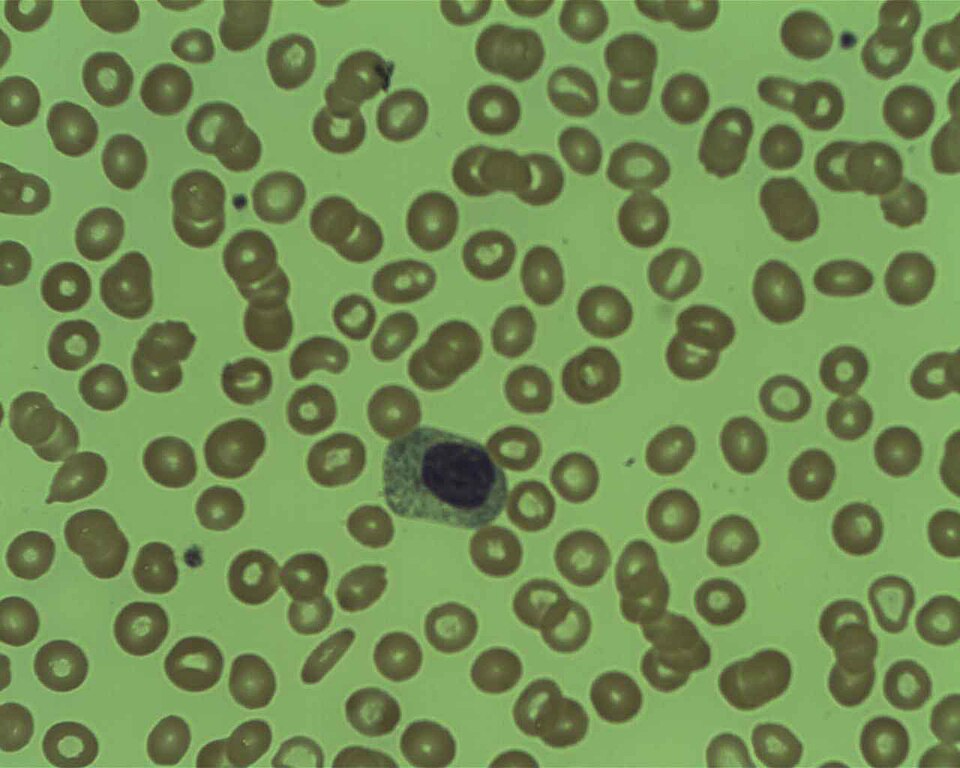
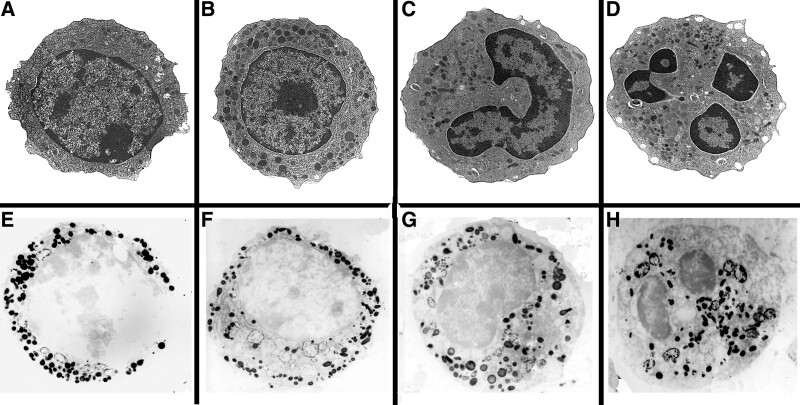
The myelocyte sits at the center of the granulocytic maturation series, with the promyelocyte as parent and the metamyelocyte as child. What defines it is the appearance of secondary granules: smaller and paler than the primary set, packed with lactoferrin and collagenase, budding from the trans-Golgi throughout this stage. Primary granules were sealed in the stage before; the Golgi here builds the new population. This is also the last stage capable of division by textbook consensus, though a 2026 in situ labeling study disputes that claim (https://pubmed.ncbi.nlm.nih.gov/42485667/). After the final division the nucleus begins to indent, the cell becomes a metamyelocyte, and the road to the mature neutrophil is set.
Bainton, Ullyot, and Farquhar: azurophil granules are made only in the promyelocyte, specific granules from the myelocyte onward. The ultrastructural basis of the staging.
Dancey and colleagues: mitotic pool (promyelocytes plus myelocytes) 2.11 x 10^9 cells/kg, postmitotic pool 5.59 x 10^9 cells/kg, transit time 6.60 days, production 0.85 x 10^9 cells/kg per day.
Athens and colleagues: the first measurement of the circulating and marginal granulocyte pools in humans.
Average circulating neutrophil lifespan of 5.4 days by in vivo labeling, at least 10 times longer than earlier ex vivo estimates.
Mass cytometry identifies a proliferative preNeu that gives rise to non-proliferating immature and mature neutrophils; preNeu requires C/EBP epsilon. Mouse data.
Transcriptome across the maturation stages of human granulopoiesis.
Commentary framing the myelocyte and metamyelocyte stage as a functionally distinct checkpoint.
Review of the active debate on neutrophil kinetics and tissue redistribution, with human and mouse differences.
Editorial comment on how mutant IDH1 disrupts granulopoiesis.
Review of human immunosuppressive neutrophils, the thread that includes myelocyte-stage cells in cancer.
Review linking emergency granulopoiesis to innate immune memory in IBD.
Without G-CSF, marrow granulopoietic precursors fall by 50 percent and blood neutrophils to 20 to 30 percent of normal.
G-CSF drives release indirectly; downregulation of stromal SDF-1 is a candidate signal.
CXCL12 on CXCR4 retains neutrophils in marrow; CXCR2 opposes it; CXCR4 dominates.
C/EBP epsilon is required for the promyelocyte to myelocyte transition.
C/EBP epsilon rises as granulocytic differentiation proceeds.
Review of how cancer rewires emergency granulopoiesis, including expansion of immature neutrophils.
Randomized trial of recombinant G-CSF, the drug that acts directly on the granulocytic precursor pool.
Review of agents that push arrested leukemic precursors toward mature forms.
Review of therapeutic angles on myeloid immunosuppression, including immature neutrophil populations.
Blocking CysLTR1 reprograms tumor-promoting myelopoiesis and restores checkpoint therapy response. Preclinical.
Single case of agranulocytosis attributed to semaglutide, treated with G-CSF.
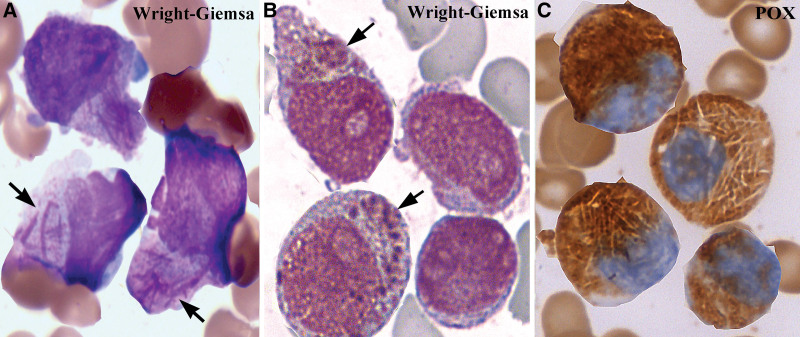
Macrocyclic peptides inhibit NSP4, a serine protease stored in primary (azurophilic) granules of myeloid precursors; potent and selective, with crystal structures solved.
Cyclic neutropenia maps to ELA2; marrow output oscillates with 21-day periodicity.
Band count of 20 percent or more: 53 percent sensitivity, 79 percent specificity for infection. Limited diagnostic value.
The current classification framework for AML and other myeloid neoplasms.
Serial immature granulocyte counts in critically ill patients associate with mortality.
Places the pro-tumor shift in myeloma at the mature neutrophil, downstream of the precursor stages.
Immature granulocyte count predicts complicated appendicitis.
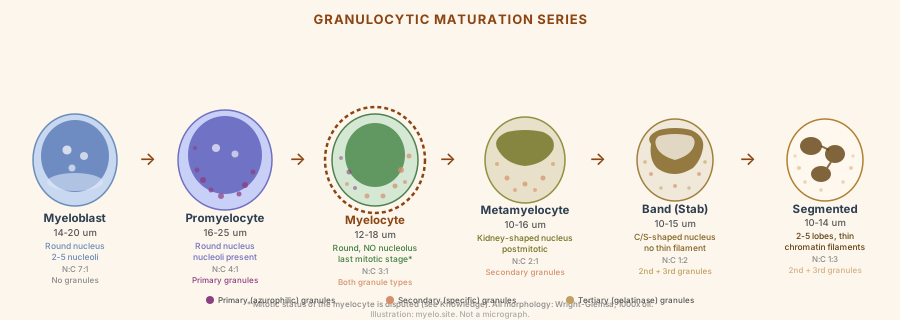
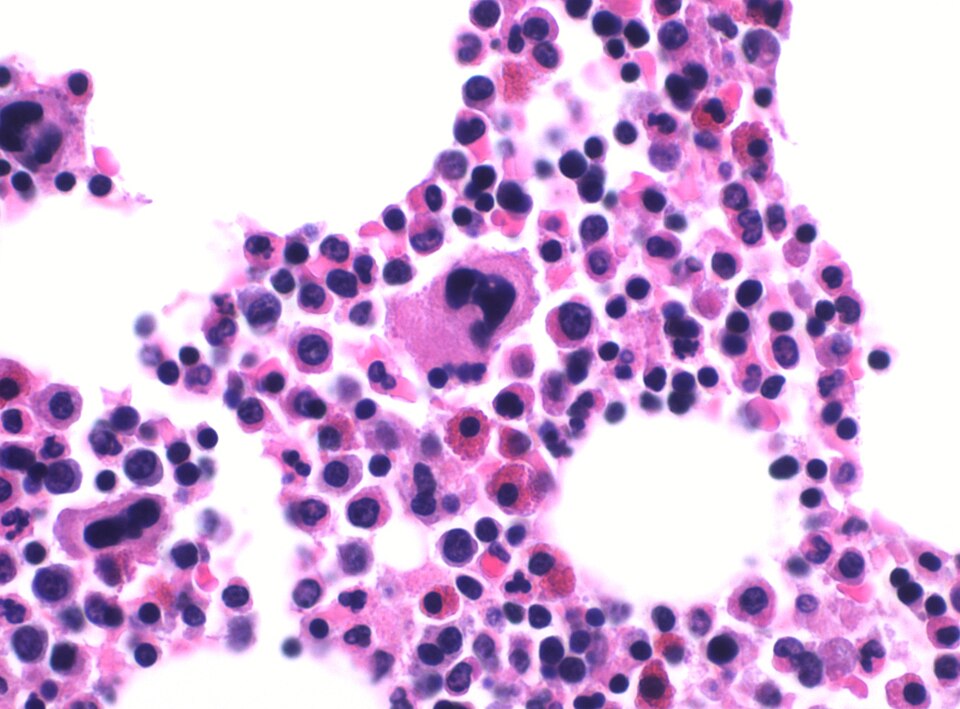
I name the parent and the child before anything else. Parent: the promyelocyte. Child: the metamyelocyte. Every claim below carries its source.
Bainton, Ullyot, and Farquhar: azurophil granules are made only in the promyelocyte, specific granules from the myelocyte onward. The ultrastructural basis of the staging.
Dancey and colleagues: mitotic pool (promyelocytes plus myelocytes) 2.11 x 10^9 cells/kg, postmitotic pool 5.59 x 10^9 cells/kg, transit time 6.60 days, production 0.85 x 10^9 cells/kg per day.
Athens and colleagues: the first measurement of the circulating and marginal granulocyte pools in humans.
Average circulating neutrophil lifespan of 5.4 days by in vivo labeling, at least 10 times longer than earlier ex vivo estimates.
Mass cytometry identifies a proliferative preNeu that gives rise to non-proliferating immature and mature neutrophils; preNeu requires C/EBP epsilon. Mouse data.
Transcriptome across the maturation stages of human granulopoiesis.
A protein made at the myelocyte stage and packed into the secondary granules forming then.
Cowland and Borregaard review granule formation as a process tied to maturation of neutrophil precursors in marrow.